
- Home
- |
- Our Culture
- Louis Riel
- Métis Firsts in North America
- Métis Minute
- Who are we?
- Métis Nation Database
- Kids' Corner
- I Love to Bead Month
- |
- Departments / Affiliates
- Citizenship
- Culture & Heritage
- Early Learning & Child Care
- Economic Development
- Education
- Energy, Infrastructure & Resource Management
- Engagement and Consultation
- Health & Wellness
- Housing and Property Management
- Identity Protection, Inter-Indigenous Relations & International Affairs
- Infinity Women Secretariat
- Louis Riel Capital Corporation
- Louis Riel College
- Louis Riel Institute
- MEDOCare Pharmacy
- Métis Child and Family Services Authority
- Métis Employment & Training
- Métis Justice Institute
- Métis Rights & Constitution
- Michif Language
- Red River Métis Business Development Corporation
- Red River Métis Community Resource
- Red River Métis Fur Company
- Red River Métis National Heritage Centre
- Red River Métis Veterans
- Riel House
- Sixties Scoop
- Youth
- |
- Government
- |
- Jobs
- |
- News
- |
- Contact
Bowling Beyond Borders: Red River Métis lawn bowler takes on international championship
November 6, 2026
Red River Métis lawn bowler Sheila Grieve represents Canada on the international stage
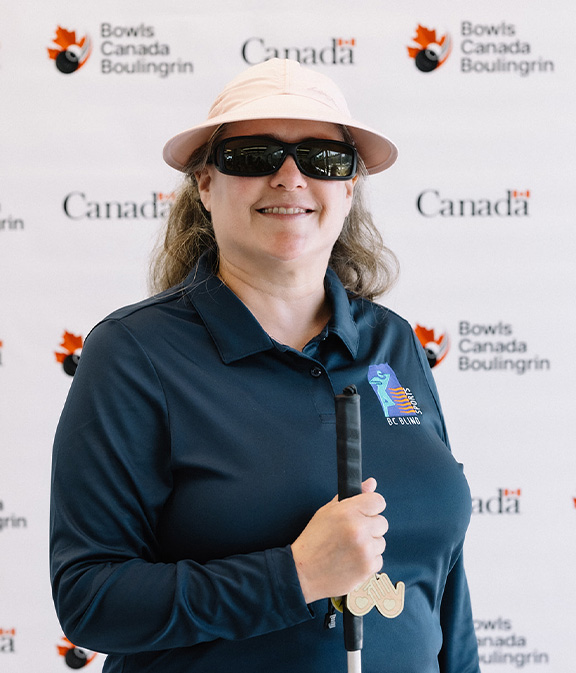
In just over two years, Sheila Grieve has gone from learning the basics of lawn bowling to competing on the international stage. Photo credit: Cuong Ly.
Sheila Grieve never thought being approached by a man in a grocery store would lead to becoming an internationally recognized lawn bowler.
The Red River Métis athlete, who is visually impaired and uses a white cane for mobility, had been approached by strangers before with questions about her vision - but this particular interaction went in an unexpected direction.
"The sweetest little old man came up to me and said, 'I see you have a white cane.' And I got all ready [to] answer questions or explain things because I love it when people ask," said Grieve. "Then he says, 'have you ever tried lawn bowling?' So, he just threw this little curveball at me and [I] said, 'well, no, no, I haven't.' And he says, 'well, why don't you come out on Tuesday morning and give it a try?'"
Not only did she give it a try, but the Red River Métis athlete thoroughly enjoyed the sport so much that within a year she tried out for the visually impaired bowling league. She competed in a full season and went on to the national championship, where she placed gold in the B4 category.
"Then I came back again this year for my second year of bowling. And again, I was lucky enough to go to the Nationals, and I was named to the [Canadian] team for the Atlantic International Challenge," she said.
The 2026 Atlantic International Challenge took place from September 6 to 10 at the Belmont Bowling Club in Belfast, Northern Ireland.
Travelling halfway across the globe, Grieve was proud of what she had achieved even before she threw her first ball.
"When I had the first team meeting online, it really started to hit me what it meant to play for Canada. And then when my Team Canada uniform arrived in the mail... I was actually rather overwhelmed by the opportunity," she said. "My whole family is very athletic, and so I know my parents would be really, really proud."
During her time in Belfast, Grieve had the opportunity to eat, sleep, and breathe lawn bowling while connecting with other visually impaired bowlers from around the world.
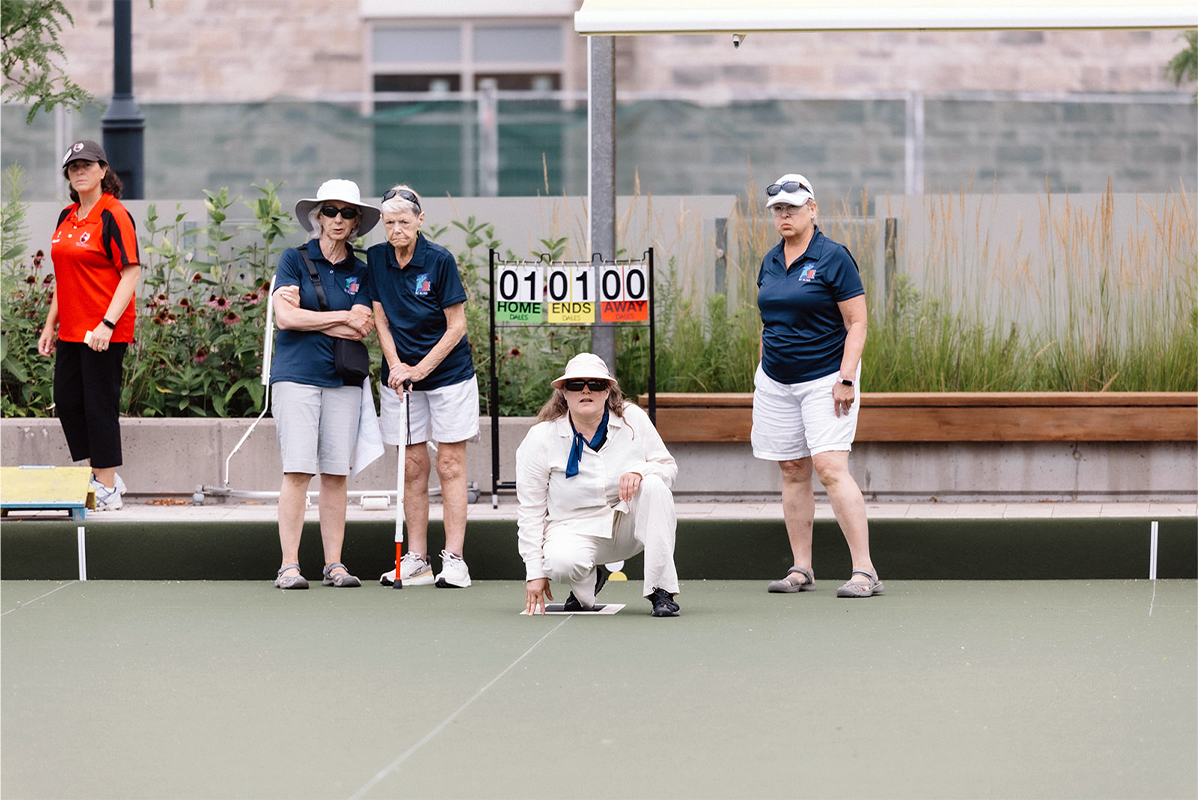 Through her experiences as a visually impaired athlete, Grieve hopes to encourage others to step outside their comfort zones and discover what they are capable of. Photo credit: Cuong Ly.
"You get up, you eat breakfast, you go to the bowling greens, you spend the day... prep your gear for the next day and do it again. And I loved it," she said. "I loved getting to meet new bowlers, some of the Canadian squad I had not met before and bowlers from Scotland and Ireland. It really expanded the lawn bowling world for me a lot."
Now that she has returned from her travels, the Red River Métis athlete is working towards her next goals in her sport.
"I've applied to be on the [international] squad for a two-year term. So, I'm hoping I'll get to do that. I've got my goals set for the winter," said Grieve. "What I'd like to work on over the winter is so that when lawn bowling season rolls around again, in mid-May, I'll be ready to step out onto the greens and just start bowling again."
As Grieve works towards those goals, she continues to embrace the process of "constantly learning" in her sport.
"I'm still a fairly new bowler... I'm still learning, and I enjoy that opportunity to constantly learn and improve... to get my aim a little bit better or to control the weight of the bowl a little bit better," said the athlete.
Grieve, who has been legally blind since 2019, has experienced firsthand how accessibility can empower people with disabilities to thrive in their everyday lives - both in her lawn bowling career and in her professional career as an early childhood education and care professor at Vancouver Island University.
In most Indigenous languages, often there is no word for disability because we look at what can that person do [and] what they bring to the community. - Sheila Grieve
"When people have access to things, then you really see the ability," she said. "When I'm at work, I'm not really disabled, because my workplace adapted the space so that I can successfully do all my jobs... whereas when I go into different settings that I'm not familiar with, then maybe that's when I'll need help."
The focus on ability rather than disability is something Grieve also explores through her work on the Family Support Institute of BC's Indigenous Advisory Circle.
"Some of us are currently creating stories about the duality of being both Indigenous and disabled, and what has our journey been like. Or to be an Indigenous family member caring for somebody with a disability, and also with that lens that disability is really a Western concept," she said. "In most Indigenous languages, often there is no word for disability, because we look at what can that person do [and] what they bring to the community."
Grieve encourages others to step outside their comfort zones and discover what they are capable of - something lawn bowling has shone a light on for her.
"No matter what level you end up doing it at, maybe you're going to end up trying a few different sports before you find one that you like, but it's really about getting out there," said Grieve. "You get to meet new people. Everybody I meet through lawn bowling and para bowling, they're fantastic... that community engagement is wonderful, and you never know where it will take you."
Shiela Grieve proudly represents all Beyond Borders Citizens with both her passion for sport and her inspiring community work. If life has taken you away from the Homeland, stay connected with your Red River Métis Government as a Beyond Borders Citizen. Visit mmf.mb.ca/beyond-borders-information to learn more!
Le boulingrin au-delà des frontières : une Métisse de la Rivière Rouge participe à un championnat international
La joueuse de boulingrin des Métis de la Rivière Rouge Sheila Grieve représente le Canada à l'étranger
En un plus de deux ans seulement, Sheila Grieve est passée de l'apprentissage du boulingrin à la compétition internationale. Photo : Cuong Ly.
Sheila Grieve n'aurait jamais pensé qu'une simple rencontre avec un inconnu dans une épicerie ferait d'elle une joueuse de boulingrin reconnue à l'échelle internationale.
L'athlète Métisse de la Rivière Rouge, qui a une déficience visuelle et qui se sert d'une canne blanche pour se déplacer, s'était déjà fait aborder par des inconnus pour se faire poser des questions sur sa vue. Cependant, cette interaction en particulier a pris une tournure tout à fait inattendue.
« Un charmant vieux monsieur s'est approché de moi et m'a dit : "Je vois que vous avez une canne blanche". Tout de suite, je me suis préparée à répondre à ses questions ou à lui expliquer ma situation, parce que j'adore quand les gens me posent des questions, raconte Sheila Grieve. C'est alors qu'il m'a demandé : "Avez-vous déjà essayé le boulingrin?" Il m'a prise de court. J'ai répondu : "Eh bien, non, jamais". Et il m'a dit : "Pourquoi ne pas venir essayer mardi matin?" »
L'athlète Métisse de la Rivière Rouge ne s'est pas contentée d'essayer; elle a tellement aimé ce sport qu'en moins d'un an, elle avait passé les sélections pour intégrer la ligue de boulingrin pour personnes ayant une déficience visuelle. Elle a mené de front une saison complète et s'est rendue jusqu'au championnat national, où elle a décroché la médaille d'or dans la catégorie B4.
« Je suis revenue cette année pour ma deuxième saison. Une fois de plus, j'ai eu la chance de participer aux championnats nationaux et j'ai été sélectionnée au sein de l'équipe [canadienne] pour le Défi international de l'Atlantique », ajoute-t-elle.
L'édition 2026 du Défi international de l'Atlantique s'est déroulée du 6 au 10 septembre au Belmont Bowling Club à Belfast, en Irlande du Nord.
À l'autre bout du monde, Sheila Grieve était déjà fière de son parcours avant même de lancer sa première boule.
« Quand l'équipe virtuelle a eu sa première rencontre, ça m'a vraiment frappée : je prenais enfin conscience de ce que ça représentait de jouer pour le Canada. Puis, quand mon uniforme d'Équipe Canada est arrivé par la poste... j'ai été profondément émue par cette chance, confie-t-elle. Tous les membres de ma famille sont de grands sportifs, et je sais que mes parents seraient vraiment très fiers ».
Durant son séjour à Belfast, Sheila Grieve a eu l'occasion de vivre à fond sa passion pour le boulingrin tout en tissant des liens avec d'autres joueuses malvoyantes venus des quatre coins du monde.
Par son parcours d'athlète malvoyante, Sheila Grieve espère encourager les gens à sortir de leur zone de confort et à découvrir de quoi ils sont capables. Photo : Cuong Ly.
« On se lève, on déjeune, on va sur le terrain, on y passe la journée... on prépare son équipement pour le lendemain et on recommence. J'ai adoré ça, dit-elle. J'ai adoré rencontrer de nouvelles joueuses, dont certains membres de l'équipe canadienne que je ne connaissais pas encore, ainsi que des joueuses d'Écosse et d'Irlande. Ça a vraiment élargi l'univers du boulingrin pour moi ».
De retour de son voyage, l'athlète Métisse de la Rivière Rouge travaille à ses prochains objectifs sportifs.
« J'ai posé ma candidature pour faire partie de l'équipe [internationale] pour un mandat de deux ans, et j'espère être sélectionnée. J'ai déjà fixé mes objectifs pour l'hiver, explique Sheila Grieve. Ce que j'aimerais faire cet hiver, c'est me préparer pour que, lorsque la saison de boulingrin reprendra, à la mi-mai, je sois prête à retourner sur le terrain et à recommencer à jouer immédiatement. »
Tout en cheminant vers ces objectifs, elle continue de s'investir dans l'« apprentissage constant » de son sport.
« Je suis encore une joueuse passablement nouvelle... J'apprends toujours, et j'aime cette occasion d'apprendre et de m'améliorer constamment... pour ajuster ma visée ou pour contrôler un peu mieux le poids de la boule », explique l'athlète.
Légalement aveugle depuis 2019, Sheila Grieve a pu constater par elle-même à quel point l'accessibilité permet aux personnes en situation de handicap de s'épanouir au quotidien, dans sa carrière tant sportive que professionnelle comme professeure en éducation et soins de la petite enfance à l'Université de l'Île de Vancouver.
Dans la plupart des langues autochtones, il n'y a souvent aucun mot pour handicap, parce que nous regardons ce que la personne peut accomplir [et] ce qu'elle apporte à la communauté. - Sheila Grieve
« Quand on a accès aux bons outils, c'est là que l'on voit vraiment nos capacités, affirme-t-elle. Quand je suis au travail, je ne me sens pas vraiment en situation de handicap, car mon milieu de travail a adapté l'espace pour que je puisse accomplir toutes mes tâches avec succès... Tandis que lorsque je me retrouve dans des endroits que je ne connais pas, c'est plutôt là que je peux avoir besoin d'aide ».
Cette priorité accordée aux capacités plutôt qu'au handicap est un aspect que Sheila Grieve explore également dans le cadre de son travail au sein du Cercle consultatif autochtone de la Colombie-Britannique du Family Support Institute.
« Certains d'entre nous préparent des récits en ce moment sur la double réalité d'être Autochtone et de vivre avec un handicap, et sur ce qu'a été notre cheminement. Ou sur ce que c'est, pour un membre d'une famille autochtone, de prendre soin d'une personne handicapée, tout en gardant à l'esprit que le handicap est en réalité un concept occidental, explique-t-elle. Dans la plupart des langues autochtones, il n'y a souvent aucun mot pour handicap, parce que nous regardons ce que la personne peut accomplir [et] ce qu'elle apporte à la communauté ».
Sheila Grieve encourage chacun à sortir de sa zone de confort et à découvrir ses propres capacités - c'est précisément ce que le boulingrin a permis d'éclairer chez elle.
« Peu importe le niveau qu'on finit par atteindre, il faudra peut-être essayer plusieurs sports différents avant de trouver le bon, mais l'essentiel, c'est vraiment de se lancer, conclut Sheila Grieve. Ça permet de faire de nouvelles connaissances. Tous les gens que je croise grâce au boulingrin et au paraboulingrin sont fantastiques... Cette mobilisation communautaire est merveilleuse, et on ne sait jamais jusqu'où cela peut nous mener ».
Sheila Grieve représente fièrement tous les citoyens et toutes les citoyennes d'au-delà des frontières tant par sa passion pour le sport que par son travail communautaire inspirant. Si la vie vous a éloigné de la Patrie, gardez le lien avec votre gouvernement Métis de la Rivière Rouge comme citoyen et citoyenne d'au-delà des frontières. Rendez-vous à mmf.mb.ca/beyond-borders-informationpour en savoir plus!

Contact Us
300-150 Henry Avenue
Winnipeg, Manitoba, Canada, R3B 0J7
x 204-586-8474 A info [at] mmf [dot] mb [dot] ca
