
- Home
- |
- Our Culture
- Louis Riel
- Métis Firsts in North America
- Métis Minute
- Who are we?
- Métis Nation Database
- Kids' Corner
- I Love to Bead Month
- |
- Departments / Affiliates
- Citizenship
- Culture & Heritage
- Early Learning & Child Care
- Economic Development
- Education
- Energy, Infrastructure & Resource Management
- Engagement and Consultation
- Health & Wellness
- Housing and Property Management
- Identity Protection, Inter-Indigenous Relations & International Affairs
- Infinity Women Secretariat
- Louis Riel Capital Corporation
- Louis Riel College
- Louis Riel Institute
- MEDOCare Pharmacy
- Métis Child and Family Services Authority
- Métis Employment & Training
- Métis Justice Institute
- Métis Rights & Constitution
- Michif Language
- Red River Métis Business Development Corporation
- Red River Métis Community Resource
- Red River Métis Fur Company
- Red River Métis National Heritage Centre
- Red River Métis Veterans
- Riel House
- Sixties Scoop
- Youth
- |
- Government
- |
- Jobs
- |
- News
- |
- Contact
Start your first Red River Métis beadwork project this I Love to Bead Month
Sydney Coutu teaches MMF Spotlight how to make a flat-stitch beadwork piece
 Follow along Red River Métis beadwork artist Sydney Coutu as she teaches us how to bead a flat-stitch blueberry piece.
Ready, set, bead! MMF Spotlight is inviting everyone to participate in I Love to Bead Month this May.
As a pillar of Red River Métis culture, beadwork is an art form that has been passed down from generation to generation. The Manitoba Métis Federation (MMF) highlights Red River Métis beaders and the importance of our traditional beadwork each May, celebrating the legacy and future of Red River Métis beadwork.
Sydney Coutu, a Red River Métis beadwork artist, is showing Citizens a simple method to start their first beadwork project using one of her favourite designs, a flat stitch blueberry.
Coutu first learned to bead during an Indigenous Summer Scholars sharing circle at the University of Winnipeg; she emphasizes the importance of continuing to pass down that knowledge.
"Now that I've honed the skills on my own - picking up bits and pieces from different sources and little tips from other people - [it] really has given me a nice push on realizing how important it is to keep passing the information along," said Coutu. "It really helped me connect myself to who I am in my community."
Coutu has done private and public workshops and hopes to continue passing on her knowledge to new beaders. She shares her beadwork primarily through her Instagram page @liirasaadbysyd.
Watch the instructional video here:
Flat-stitch blueberry walk-through
The beadwork artist chose a blueberry for the demonstration because of its significance to Red River Métis culture.
The flat-stitch beadwork blueberry walk-through will consist of six steps: design, beginning, outline, filling, backing, and edging.
 Coutu presents the completed flat-stitch blueberry piece. The blueberry is an important symbol of Red River Métis sustenance and resilience.
"Flat stitch beadwork is when you are beading onto your Pellon, onto your hide. It's in the name where you're beading onto your flat surface," said Coutu. "You can make pins, you can make medallions, bolos, you can make so many things out of that. It's really up to what you want to make it."
 Beading supplies can vary and it may take time to determine what works best for you.
Before you start to bead, you'll need the materials listed below, which can be found at local craft stores and specialty beading shops.
- Leather cutting scissors
- Pliers
- Beading mat
- Pen
- Scissors
- Beads
- Backing
- Lighter
- Pellon
- Beading thread
- Fabric glue
- Cardboard
- Needles
A lot of these materials will vary depending on preferences and the nature of your project, such as needle and bead size, colour of beads, colour of beading thread and choice of glue. Coutu uses size 11 beads, white beading thread, a long needle, E600 glue, and leather backing for this project.
 Beadwork artist Coutu uses pen on Pellon to trace the blueberry design.
The design template is what you will follow for the creation of the project. Some beaders will draw a pattern straight on the Pellon; others use tracing paper to draw a template, then stitch the paper directly on to the Pellon, securing the guide.
For the flat-stitch blueberry, Coutu created their own template using a real-world reference, she then traced the design onto Pellon then cut the Pellon out of the larger sheet of fabric.
"I will take a pre-existing piece [and] I will put it on a piece of Pellon and trace it," said Coutu. "Alternatively, you can use (Microsoft) Word preset shapes to make your own template so that they're super round or straight, but I like asymmetrical patterns when it comes to real life vegetables and fruits."
Before moving onto beading, make sure you cut out your piece of Pellon to allow room to work, but not so much that it becomes difficult to handle in your hands. Leave roughly an inch between the edge of the Pellon and where the template is traced.
 Coutu doubles and knots her thread for the two-needle method.
Before we begin to bead, we need to prepare our beads and thread. Pour out some of your beads onto your beading mat - a tool used to prevent the beads from rolling away while also making it easier to pick up with your needle.
For the flat-stitch blueberry, Coutu begins with the blue beads to make the circle and body of the berry.
Finally, prepare your needles and thread. It's easy to snap your needles, so it's a good idea to have a few extras on hand. Prepare your beading thread by coating it in beeswax - this will help prevent it from knotting.
Coutu uses the two-needle method of beading.
 Coutu carefully prepares her thread for the two-needle method and begins counting out beads added to her thread.
For your first needle and thread: you will put your thread through the eye of the needle and pull until both ends of the thread meet and tie those ends together, creating a doubled thread; this is used to add beads to the piece.
For the second needle and thread: pull the thread through the eye of the needle but do not have the ends meet. Tie the single end of the thread into a knot; this will be used to tack down and secure your beads.
"We just need to tie one end [of the thread] and tie it a couple times, just in case, because it can go all the way through the material," said Coutu.
Coutu uses a lighter to burn the end of the thread, ensuring the knot is secure.
 Coutu demonstrates the 29-bead circle outline of the patchwork blueberry.
Coutu begins the beadwork by starting her needle from the back of the piece to the front (where the template is drawn), through the Pellon, at the base of the blueberry template.
For the outline of the blueberry, she loads 29 beads onto the doubled needle and thread. This line of beads will create the circle outline of the blueberry. The number of beads will vary based on the size of the design you are creating.
"I always just start a little bit inward from where my lines are," said Coutu. "Keeping in consideration that your template is bigger than your actual piece."
Once you've counted your beads and are ready to secure them, pull your needle through the first 3 beads you loaded on to your thread, this will form the circle shape.
Next, you will work your needle through the Pellon, from the front to the back, next to where you first entered with your needle; this will add your beaded circle onto the piece. Place your doubled needle and thread to the side.
Next, and very importantly, you will tack down your beads to secure them onto the Pellon.
"Since we have our beads on, now you'll use your second needle and you'll begin tacking," said Coutu. "I like to use my thumb, especially when making curved shapes, because you have a natural curve in your thumb or in your fingernail to help you with the curves."
 Coutu demonstrates how to use the shape of your thumb to help form your beadwork as you tack it in place.
Using your thumb to guide the shape, pull your single-layered threaded needle from the back of the piece to the front, just on the outside of your beads. You will then take the single-layered thread on the inside of your beads, back through the front of the piece, holding the doubled thread and your beads in place against the Pellon surface.
"What this is doing is it is creating a loop around your string holding the bead so that your bead stays in place," said Coutu. "Some people will tack every two to three beads. I like to tack every single bead because it makes me feel more secure, but everybody is different."
Continue to tack down the entire circle.
 The Red River Métis beadwork artist begins filling the circle of the blueberry by creating a seven-bead circle and filling it in with a single bead.
Next, you will fill in the blueberry outline. Beginning at the pit of the blueberry, you will add a small circle to create the pit effect.
"For the next circle, I will go kind of in the middle... that's where I want the centre of my blueberry pit to be," said Coutu. "To get one nice circle, it will take seven beads."
Following the steps to make the circular outline of the blueberry, you'll now create a smaller circle, using seven beads.
Once the small circle has been added; you will tack the beads down with the single-layered thread. To finish off the pit, you will take a single bead and fill in the centre of the pit.
Then, you will fill in the rest of the blueberry with rows of blue beads following the curve of the outline inward to meet the blueberry pit.
While you want to ensure the space is full, you also don't want to add too many beads and cause bunching.
"When you're filling in a space on the side, instead of adding all of your beads onto your string, I'm just going to add one [at] a different angle," Coutu advised. "A sideways piece will fit better in some spaces than your line that you've been doing already."
After every line, place your doubled thread and needle to the side without pulling it through your piece, and tack the beads down with your second needle and thread.
 After completing the blueberry, Coutu will bead the outline of the leaves before filling them in.
Once the body of the blueberry is done, you can use the same methods with different bead colours to create the outlines of the leaves, then fill them in. The number of beads used will vary depending on your design, you can add and take away beads as needed to ensure your outline is complete.
"Instead of just going around in a circle ,you're just kind of following the outlines until you make your way to the middle," said Coutu.
The very middle of each leaf is then filled with a single line.
When you're done outlining and filling your entire piece, you can cut your excess fabric off your piece of Pellon. Leave a small border of space around your piece to ensure you don't cut your tacking thread and undo your hard work.
 Using E600 multi-purpose glue, Coutu adheres the cardboard to the Pellon, and then the leather backing as the third and final layer.
You'll need to add materials to the back of your piece to hide and protect the thread on the back of the Pellon; this will bring us one step closer to a finished piece.
Coutu uses cardboard and leather to back the piece, but there are many options a beader can explore.
"We are going to trace out our blueberry onto some backing," said Coutu.
Coutu uses a thin sheet of cardboard between the Pellon and the leather backing to create stability in the piece. But you must cut it out smaller than the Pellon and the leather, so you won't need to work your needle through a tough surface in the final step.
"Now you glue them all together. You'll glue your cardboard down, then your leather on top of them, and you'll let that dry," said Coutu.
Once the glue is dry and everything is secured together, you can use your leather scissors to trim the leather to the size of the beaded piece.
 Coutu displays how the edging will look once completed.
To secure the three layers of the piece together, you'll need to add edging along the sides of the entire piece.
The edging Coutu uses is the one bead method: creating a small, beaded border around the edge.
Using a single layered thread on a needle, weave through just the Pellon fabric, hiding the knot between the layers of your piece.
"We're going to want to now go through both layers close to [the point we just came through and] pull [your thread] all the way through," said Coutu, as she went from the back of her piece with her needle, to the front.
"This is where the pliers might come in handy if you're not very dexterous or you don't have much strength in your hands," she said. "When it's going through the leather, you can grab close to the end and then pull."
 Coutu feeds her needle from the back of the piece to the front, preparing to add another bead to the edging.
Once you've gone through the layers of Pellon and leather backing entirely, your needle and thread should be coming out of the front of your piece. You can then add a bead to your thread and go back through the layers once more, from front to back and you will now have one bead secured to the edge.
Next, you will put your needle through the middle of the bead so that it is taut to the side of your piece and the hole of the bead is facing outward.
You will then continue repeating those steps all the way around; taking your needle and thread through the back of the piece to the front, adding a bead, going through the front of your piece to the back, and then weaving your thread through the bead you just added.
When you've gone all the way around the edge to where you started, you will tack through the first bead you started with and go through the backing layer. Then you can tie off and cut your thread, before burning the end of your thread to secure the knot.
Now you have completed your first flat-stitch piece!
 Red River Métis beadwork artist Sydney Coutu generously shares her beadwork knowledge to those curious to learn a part of their culture and history.
Watch out for beading workshops in your Region through the MMF's events page. To keep up with Sydney Coutu, find out when she's hosting her next workshop, or meet her in person at the next market, follow her on Instagram at @liirasaadbysyd.
Share your I Love to Bead Month beadwork projects with us! Send a photo of our piece (or your own creations) via direct message to our Instagram page @manitobametisfederation or email us at communications@mmf.mb.ca.
Lancez-vous dans votre premier projet de perlage Métis de la Rivière Rouge à l'occasion du Mois du perlage
Sydney Coutu explique à MMF Spotlight comment réaliser une pièce de perlage à point plat
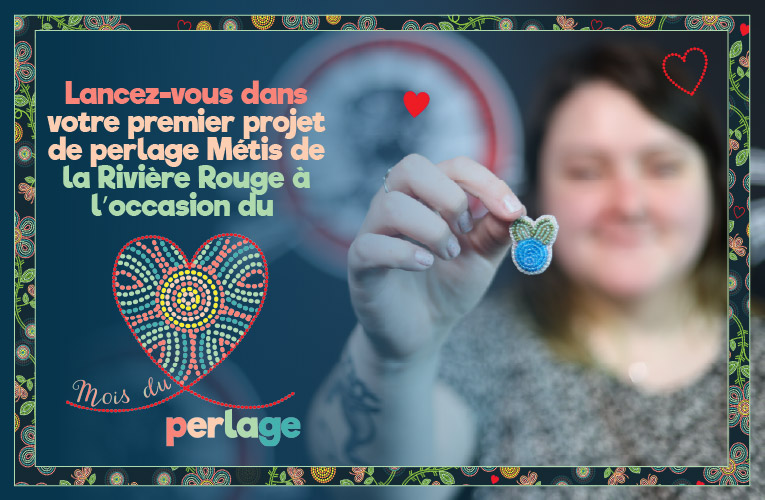
Venez découvrir comment réaliser un motif de bleuet à point plat avec Sydney Coutu, perleuse métisse de la Rivière Rouge.
À vos marques, prêts, perlez! MMF Spotlight vous invite à participer au Mois du perlage en mai.
Pilier de la culture métisse de la Rivière Rouge, le perlage est un art qui se transmet de génération en génération. Chaque année en mai, la Fédération Métisse du Manitoba (FMM) met à l'honneur les perleuses métisses de la Rivière Rouge et souligne l'importance de notre perlage traditionnel, célébrant ainsi l'héritage et l'avenir de cet art.
Sydney Coutu, perleuse métisse de la Rivière Rouge, explique une méthode simple pour se lancer dans un premier projet de perlage en utilisant l'un de ses motifs préférés : un bleuet à point plat.
Mme Coutu a découvert le perlage lors d'un cercle de partage organisé dans le cadre du programme Indigenous Summer Scholars à l'Université de Winnipeg; elle insiste sur l'importance de continuer à transmettre ce savoir.
« Maintenant que j'ai perfectionné mes compétences par moi-même - en puisant ici et là dans différentes sources et en recueillant de petits conseils auprès d'autres personnes -, je réalise à quel point il est important de continuer à transmettre ces connaissances », déclare Mme Coutu. « Cela m'a vraiment aidée à trouver ma place au sein de ma communauté. »
Mme Coutu a animé des ateliers privés et publics et espère continuer à transmettre son savoir à de nouveaux adeptes du perlage. Elle partage principalement ses créations sur sa page Instagram @liirasaadbysyd.
Tutoriel sur la technique à point plat d'un motif de bleuet
Visionnez la vidéo explicative ici :
L'artiste perleuse a choisi un motif de bleuet pour cette démonstration en raison de son importance dans la culture métisse de la Rivière Rouge.
Le tutoriel sur le perlage du bleuet à point plat comprend six étapes : le motif, les préparatifs, le contour, le remplissage, le renfort et la bordure.
Mme Coutu présente la pièce terminée du bleuet à point plat. Le bleuet est un symbole important de la subsistance et de la résilience des Métis de la Rivière Rouge.
« Le perlage à point plat consiste à perler sur du Pellon ou sur de la peau. Comme son nom l'indique, on perle sur une surface plane », explique Mme Coutu. « On peut en faire des broches, des médaillons, des bolos... on peut en faire tellement de choses. Tout dépend vraiment de ce dont on a envie. »

Le matériel nécessaire au perlage peut varier et il vous faudra peut-être un certain temps pour déterminer ce qui vous convient le mieux.
Avant de vous lancer dans le perlage, vous aurez besoin du matériel indiqué ci-dessous, que vous trouverez dans les magasins d'artisanat locaux et les boutiques spécialisées dans le perlage.
- Ciseaux pour le cuir
- Pinces
- Tapis de perlage
- Stylo
- Ciseaux
- Perles
- Toile de renfort
- Briquet
- Pellon
- Fil à perler
- Colle à tissu
- Carton
- Aiguilles
Le choix de certains de ces matériaux dépendra de vos préférences et de votre projet, notamment la taille de l'aiguille et des perles, la couleur des perles, la couleur du fil à perler et le type de colle utilisé. Pour ce projet, Mme Coutu utilise des perles de taille 11, du fil à perler blanc, une longue aiguille, de la colle E6000 et un renfort en cuir.

L'artiste perleuse utilise un stylo sur du Pellon pour tracer le motif du bleuet.
Le gabarit représente le modèle que vous suivrez pour la réalisation du projet. Certaines personnes dessinent leur motif directement sur le Pellon; d'autres utilisent du papier calque pour tracer un gabarit, puis cousent le papier directement sur le Pellon afin de le maintenir en place.
Pour le bleuet à point plat, Mme Coutu a créé son propre gabarit à partir d'un modèle réaliste; elle a ensuite tracé le motif sur une feuille de Pellon, qu'elle a par la suite découpée en suivant la forme du motif.
« Je prends un motif existant, je le pose sur un morceau de Pellon et je le trace », explique Mme Coutu. « On peut aussi utiliser les formes prédéfinies de Microsoft Word pour créer son propre gabarit, afin d'obtenir des formes parfaitement rondes ou droites, mais j'aime les motifs asymétriques quand il s'agit de fruits et légumes réalistes. »
Avant de passer au perlage, assurez-vous de couper votre morceau de Pellon de manière à disposer d'un espace suffisant pour travailler, sans pour autant qu'il soit trop difficile à manipuler. Laissez environ un pouce entre le bord du Pellon et le tracé du gabarit.

Mme Coutu double son fil et fait un nœud pour la technique à deux aiguilles.
Avant de commencer à perler, il faut préparer les perles et le fil. Versez quelques-unes de vos perles sur votre tapis de perlage - un accessoire qui empêche les perles de s'éparpiller et qui facilite leur prise avec l'aiguille.
Pour le bleuet à point plat, Mme Coutu commence par les perles bleues afin de former le cercle et le corps du fruit.
Enfin, préparez vos aiguilles et votre fil. Les aiguilles se cassent facilement, il est donc conseillé d'en avoir quelques-unes en réserve. Préparez votre fil à perler en l'enduisant de cire d'abeille, cela l'empêchera de s'emmêler.
Mme Coutu utilise la technique du perlage à deux aiguilles : une aiguille sert à ajouter les perles et l'autre à les piquer.
Mme Coutu prépare soigneusement son fil pour la technique à deux aiguilles et commence à compter les perles qu'elle enfile.
Pour votre première aiguille : passez le fil dans le chas de l'aiguille et tirez jusqu'à ce que les deux extrémités se rejoignent. Nouez ces extrémités ensemble pour obtenir un fil double; cette aiguille à fil double servira à ajouter des perles à votre pièce.
Pour la deuxième aiguille : passez un autre fil dans le chas de l'aiguille sans que les extrémités se rejoignent. Faites un nœud à l'une des extrémités du fil; cette aiguille à fil simple servira à piquer vos perles et à les maintenir en place.
« Il suffit de faire un nœud à une seule extrémité du fil, et de faire quelques nœuds de plus afin d'éviter que le fil ne traverse complètement le tissu », explique Mme Coutu.
Elle utilise un briquet pour brûler l'extrémité du fil, ce qui assure la solidité du nœud.

Mme Coutu montre comment tracer le contour à 29 perles du bleuet.
Mme Coutu commence le perlage en enfonçant son aiguille de l'envers vers l'endroit (là où le gabarit est dessiné), à travers le Pellon, à la base du bleuet.
Pour le contour du bleuet, elle enfile 29 perles sur l'aiguille à fil double. Cette rangée de perles servira à créer le contour du bleuet. Le nombre de perles varie en fonction de la taille du motif que vous réalisez.
« Je commence toujours un peu en dedans par rapport au tracé », explique Mme Coutu. « Il faut garder en tête que le gabarit est plus grand que la pièce elle-même. »
Une fois que vous avez compté vos perles et que vous êtes prêt à les fixer, passez votre aiguille à travers les trois premières perles qui sont sur votre fil; cela permettra de former le cercle.
Ensuite, passez votre aiguille à travers le Pellon, de l'avant vers l'arrière, juste à côté de l'endroit où vous avez initialement enfoncé votre aiguille; cela permettra de fixer votre cercle de perles sur la pièce. Mettez de côté votre aiguille à fil double.
Ensuite, étape très importante, vous allez piquer vos perles pour les fixer sur le Pellon.
« Maintenant que les perles sont en place, vous allez utiliser votre deuxième aiguille et commencer à piquer », explique Mme Coutu. « J'aime bien utiliser mon pouce, surtout pour réaliser des formes courbes, car le pouce et l'ongle ont une courbure naturelle qui facilite la réalisation des courbes. »
Mme Coutu montre comment utiliser la forme de son pouce pour aider à façonner sa pièce de perles au moment de piquer les perles en place.
En guidant la forme avec votre pouce, faites passer votre aiguille à fil simple de l'arrière vers l'avant de la pièce, tout près du côté extérieur de vos perles. Ramenez ensuite votre aiguille à fil simple de l'avant vers l'arrière de la pièce en la piquant du côté intérieur des billes, tout en maintenant le fil double et vos perles en place contre la surface du Pellon.
« Cela permet de créer une boucle autour du fil qui retient la perle, afin que celle-ci reste en place », explique Mme Coutu. « Certaines personnes piquent toutes les deux ou trois perles. Je préfère piquer chaque perle, car cela me rassure, mais chaque personne a ses préférences. »
Continuez à piquer tout autour du cercle.

La perleuse métisse de la Rivière Rouge commence à remplir le bleuet en créant un cercle de sept perles, puis en le remplissant avec une seule perle.
Ensuite, vous remplissez le bleuet. En partant du centre du bleuet, vous ajoutez un petit cercle pour créer le noyau.
« Pour le cercle suivant, je me place un peu au milieu... c'est là que je veux que se trouve le centre du noyau de mon bleuet », explique Mme Coutu. « Pour obtenir un beau cercle, il faudra sept perles. »
En suivant les mêmes étapes que celles pour le contour du bleuet, vous allez maintenant créer un cercle plus petit, à l'aide de sept perles.
Une fois le petit cercle ajouté, vous piquez les perles avec l'aiguille à fil simple. Pour finir le noyau, vous prenez une seule perle que vous piquez au centre du noyau.
Ensuite, vous remplissez le reste du bleuet avec des rangées de perles bleues en suivant la courbe du contour vers l'intérieur jusqu'au noyau du bleuet.
Même si vous devez veiller à ce que l'espace soit bien rempli, il faut éviter d'ajouter trop de perles pour ne pas créer de plis.
« Lorsqu'on remplit un espace sur le côté, au lieu d'enfiler toutes les perles sur le fil, on peut simplement en ajouter une à un angle différent », conseille Mme Coutu. « Une perle placée de côté s'intégrera mieux dans certains espaces que la rangée que vous avez déjà réalisée. »
Après chaque rangée, placez votre aiguille à fil double sur le côté sans la faire passer à travers votre pièce, puis fixez les perles avec votre aiguille à fil simple.
Une fois le bleuet terminé, Mme Coutu trace le contour des feuilles avant de les remplir.
Une fois le corps du bleuet terminé, vous pouvez utiliser les mêmes techniques avec des perles de différentes couleurs pour dessiner le contour des feuilles, puis les remplir. Le nombre de perles utilisées variera en fonction de votre motif; vous pouvez en ajouter ou en retirer selon vos besoins pour vous assurer que le contour est bien tracé.
« Au lieu de tourner simplement en rond, il suffit de suivre les contours jusqu'à ce que vous arriviez au centre », explique Mme Coutu.
Le centre de chaque feuille est ensuite rempli d'une seule rangée.
Une fois que vous avez tracé les contours et rempli l'ensemble de votre pièce, vous pouvez couper l'excédent de tissu de votre morceau de Pellon. Laissez une petite bande autour de votre pièce pour éviter de couper le fil de piquage et de perdre tout votre travail.

À l'aide de la colle multi-usage E6000, Mme Coutu colle le carton sur le Pellon, puis le renfort en cuir comme troisième et dernière couche.
Il faut ajouter du matériel au dos de la pièce afin de recouvrir et de protéger le fil situé à au dos du Pellon; le projet est maintenant presque terminé.
Mme Coutu utilise du carton et du cuir pour renforcer la pièce, mais il y a plusieurs autres possibilités.
« Nous allons tracer notre bleuet sur un renfort », explique Mme Coutu.
Mme Coutu utilise une mince feuille de carton entre le Pellon et le renfort en cuir pour assurer la stabilité de la pièce. Il faut toutefois la découper dans des dimensions plus petites que celles du Pellon et du cuir, afin de ne pas avoir à enfoncer l'aiguille dans une surface trop rigide lors de la dernière étape.
« Il faut maintenant tout coller ensemble. Commencez par coller le carton, puis le cuir par-dessus, et laissez sécher », explique Mme Coutu.
Lorsque la colle est sèche et que tout est bien en place, vous pouvez utiliser vos ciseaux pour le cuir pour découper le cuir à la taille de la pièce.

Mme Coutu montre à quoi ressemblera la bordure une fois terminée.
Pour assurer la solidité des trois couches de votre pièce, vous devrez ajouter une bordure tout autour.
La technique utilisée par Mme Coutu consiste à créer une petite bordure en perles sur le pourtour de la pièce.
À l'aide d'une aiguille à fil simple, faufilez le fil uniquement à travers le tissu Pellon, en dissimulant le nœud entre les couches de la pièce.
« Nous allons maintenant passer à travers les deux couches près de l'endroit que nous venons de traverser et ensuite tirer le fil complètement de l'autre côté », explique Mme Coutu, tout en faisant passer son aiguille de l'arrière à l'avant de sa pièce.
« C'est là que les pinces peuvent s'avérer utiles si vous n'êtes pas très habile ou si vous n'avez pas beaucoup de force dans les mains », ajoute-t-elle. « Quand le fil traverse le cuir, vous pouvez le saisir près de l'extrémité, puis tirer. »
Mme Coutu fait passer son aiguille de l'arrière vers l'avant de la pièce, s'apprêtant à ajouter une autre perle à la bordure.
Une fois que vous avez traversé toutes les couches de Pellon et de renfort en cuir, votre aiguille et votre fil devraient ressortir par l'avant de votre pièce. Vous pouvez alors enfiler une perle sur votre aiguille et repasser à travers les couches une autre fois, de l'avant vers l'arrière; vous aurez ainsi une perle solidement fixée au bord.
Ensuite, vous passez votre aiguille au centre de la perle pour qu'elle soit tendue sur le côté de votre pièce et que le trou de la perle soit tourné vers l'extérieur.
Vous répétez ensuite ces étapes tout autour de la pièce : passez votre aiguille et votre fil de l'arrière vers l'avant de la pièce, ajoutez une perle, repassez de l'avant vers l'arrière, puis passez votre fil dans la perle que vous venez d'ajouter.
Une fois que vous avez fait le tour complet jusqu'à votre point de départ, vous piquez à travers la perle avec laquelle vous avez commencé et vous traversez la couche de renfort. Vous pouvez alors nouer et couper le fil, avant d'en brûler l'extrémité pour fixer le nœud.
Vous venez de terminer votre première pièce de perlage à point plat!
Sydney Coutu, perleuse métisse de la rivière Rouge, transmet généreusement son savoir-faire à ceux qui souhaitent s'initier à une partie de leur culture et de leur histoire.
Restez à l'affût des ateliers de perlage organisés dans votre région en consultant la page des événements de la FMM. Suivez Sydney Coutu sur Instagram à l'adresse @liirasaadbysyd pour savoir quand elle animera son prochain atelier ou pour la rencontrer en personne lors du prochain marché.
Partagez avec nous vos projets réalisés dans le cadre du Mois du perlage! Envoyez une photo de notre pièce (ou de vos propres créations) par message privé sur notre page Instagram @manitobametisfederation ou par courriel à communications@mmf.mb.ca.

Contact Us
300-150 Henry Avenue
Winnipeg, Manitoba, Canada, R3B 0J7
x 204-586-8474 A info@mmf.mb.ca
